
 Available in GB
Content
- A provider name is not a casino
- The slot format behind the available evidence
- Casino listings are not a licensing register
- What UK regulation governs—and what it does not establish
- Why a provider claim cannot become a ‘top sites’ list
- Real-money play, demo versions and changing RTP
- The operator, not the supplier, handles the account
- Mobile play without a separate download
- A review cannot supply a missing game catalogue
- Inspired games remain unverified in the supplied evidence
The available material distinguishes game suppliers from operators, but does not verify which UK casinos offer Inspired Gaming titles.
A provider name is not a casino
A casino and the company that supplies its games occupy different places in the business. One operates the account, presents a lobby and accepts wagers; the other makes software that an operator may choose to carry. The distinction is easy to lose when a provider’s name appears beside a casino brand, but it matters: a supplier is not, by that fact alone, a place where anyone can open an account or play.
Amatic Industries GmbH is an Austrian business-to-business software supplier, founded in 1993. It does not run casinos for individual customers. Its role is to provide games to operators, rather than to offer a consumer-facing gambling service under its own name. That makes Amatic relevant to discussions of casino software, but not a casino destination in the ordinary sense.
The route from supplier to player runs through an operator. Amatic titles reach UKGC-licensed operators through direct integrations or aggregator feeds. In the first arrangement, a casino connects with the provider’s games directly; in the second, a distribution platform can make titles from multiple suppliers available to operators. Either way, the player encounters the game inside an operator’s service. Amatic’s catalogue is not sold as a standalone product for consumers.
That distinction also sets a boundary around claims about Inspired Gaming. The question of which UK casinos offer games under the Inspired name is not answered by information about Amatic Industries. They are separate provider names, and one company’s distribution arrangements cannot establish another’s casino presence. A page about the best Inspired Gaming casinos in the UK therefore needs evidence about Inspired titles and the operators that actually make them available. Amatic’s business model cannot fill that gap.
It is tempting to treat a supplier name as a shortcut. A game provider is visible in a casino lobby; the lobby belongs to a familiar operator; the two names begin to blur into a single brand. But the commercial relationship is not the same as a shared identity. A supplier creates or distributes software. An operator builds the service around it. The name on a game is not automatically the name over the door.
iSoftBet Casinos in the UK: What Can Be Verified
This is more than a technical distinction. Casino language often compresses a chain of companies into one neat label because the player sees a single screen. Behind that screen, the business is divided: software is developed and supplied, distribution connects products to platforms, and the operator presents them as part of a gambling service. Each link has its own function. Confusing those functions produces confident-sounding descriptions of casinos that the provider itself does not operate.
For the same reason, the phrase “Inspired casino” can mean several things in casual use. It might refer to a casino carrying Inspired-branded games, a site associated with a company named Inspired, or merely a search for somewhere to play a particular title. Those are not interchangeable claims. To name a casino as a place offering Inspired games requires a connection between that operator and those games; to call a software supplier a casino requires an entirely different and plainly mistaken leap.
Amatic illustrates the narrower point. Its games can be supplied to UKGC-licensed operators, but Amatic itself does not take on the consumer-facing role implied by a casino listing. The company is part of the supply side of the market, not a branded room in which players register and wager. Its Austrian origin and business-to-business status describe the supplier; they do not turn it into an online casino.
A useful account of casino brands must therefore keep the nouns in their proper places. “Provider” describes a company furnishing software. “Operator” describes the business offering the gambling service. A game’s presence under one operator’s roof says something about that operator’s catalogue, not that the supplier owns or runs the casino. And a statement about Amatic says nothing, by itself, about Inspired Gaming.
The distinction may seem small beside the spectacle of a game, with its symbols, sounds and moving reels. Yet it is the part that keeps a description honest. A supplier can be named without being mistaken for a casino; a casino can be discussed without attributing another company’s games to it. The labels are not decoration. They describe who does what.
Provider vs Operator
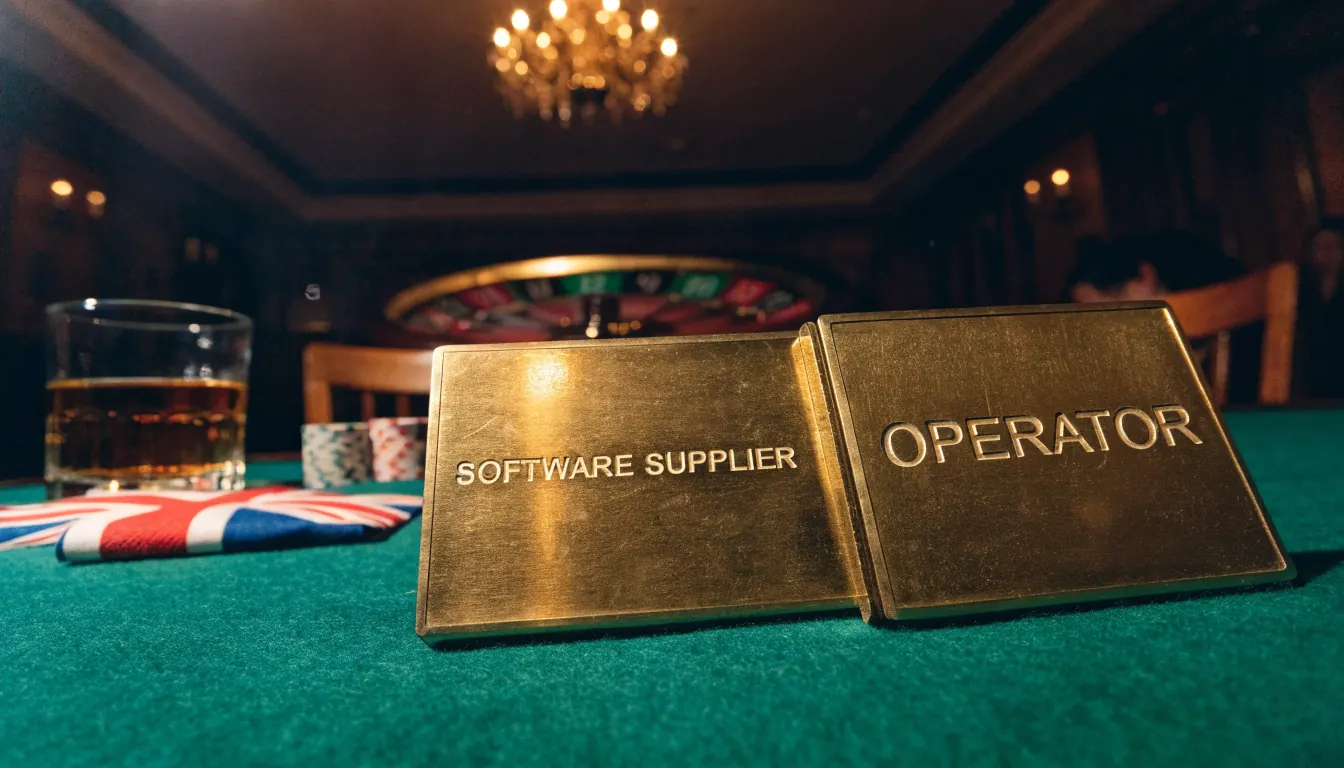
A software supplier is not a casino; it provides the games, while the operator manages the accounts and services.
For a UK casino search built around Inspired Gaming, the provider identity has to be established before any operator can be described as a destination for its games. Amatic Industries is a real supplier with a defined business-to-business role, but that role belongs to Amatic. The names cannot be swapped, and the casinos cannot be inferred from the supplier alone.
Separate businesses. Separate claims.
The slot format behind the available evidence
A typical Amatic video slot is built around a familiar-looking grid: five reels, each showing three positions, with nine or ten fixed paylines. That description is about the game’s structure, not a catalogue of Inspired-branded titles. The distinction matters because names can drift in online casino language: a company, a supplier and a game label may sit close together on a page without meaning the same thing.
The grid is the visible part of the format. Reels provide the columns; rows provide the positions in which symbols appear. Together, the five-by-three arrangement gives a player a compact field to read after a spin. It is a simple architecture, but not a simple promise. The arrangement says how symbols are displayed, not how often a particular result will occur or what any winning combination will pay.
Paylines are another piece of the vocabulary. In this format, the number is fixed at nine or ten, rather than described as changing from one spin to the next. A payline is a route through the grid on which a qualifying symbol pattern may be assessed. The word “fixed” is therefore useful: it identifies a stable feature of the game’s layout. It does not, by itself, explain every symbol rule, the value of a result or the conditions attached to a particular title.
Relax Gaming Online Casinos UK: Slots and Licensing
That distinction can get lost when slots are reduced to a row of icons and a short promotional label. A fixed line count is a mechanical property; it is not a measure of generosity. Nor does a larger number of lines necessarily tell anyone what a session will feel like. The format establishes the paths used to assess combinations, while the individual game determines the symbols and the terms under which those paths matter.
Scatter pays sit alongside paylines in the typical structure. Their presence means that the game’s assessment is not confined to the fixed routes across the reels. A scatter is a separate category of symbol treatment, rather than another name for a payline. The description of the format does not supply a universal rule for how many scatters are needed, where they must land or what a particular scatter result pays. Those details belong to the individual game, not to the broad outline of the format.
Then there is the “Book of” style free-spin round. The phrase describes a recognisable feature within the slot format, but it should not be mistaken for a complete set of rules. The label alone does not establish how a round begins, how many spins it contains, whether symbols behave differently during it or what its outcome will be. Those are game-specific matters. The useful point is narrower: the typical Amatic video slot may combine its standard reel-and-line structure with a free-spin feature in this style.
Grid Structure
Five reels and three rows providing a compact field for symbol display.
Fixed Paylines
Nine or ten stable routes used to assess qualifying symbol patterns.
Scatter Pays
Special symbol treatments that are not confined to fixed paylines.
Free-Spin Round
"Book of" style features that add layers to the standard reel-and-line structure.
This combination gives the format several layers without making the underlying grid mysterious. There are reels and visible positions; fixed lines for assessing certain patterns; scatter pays that are treated separately; and a feature round associated with the “Book of” style. Each term names a different part of the game. Blending them into a general claim that a slot is “feature rich” would say less than the mechanical description does.
For someone comparing titles, the format can serve as a first reading of the screen. Five reels and three rows describe the frame. Nine or ten fixed paylines describe one part of the way results are assessed. Scatter pays indicate another. A “Book of” free-spin round signals a feature type. None of those labels, taken alone, identifies a particular Inspired game or establishes that an Inspired-branded slot uses the same arrangement.
That is where provider language needs care. Amatic is the name attached to the format described here; “Inspired” is a different name in the casino search context. Similar-looking product pages, broad category labels or a shared presence in a casino lobby cannot turn one supplier’s mechanics into another supplier’s catalogue. The details above belong to the Amatic slot format, and should stay attached to it.
There is a modest pleasure in such plain descriptions. They do not attempt to make a grid sound like a secret, or a free-spin round like a guarantee. They tell what is on the screen and what kinds of mechanics sit around it. The rest depends on the rules of the individual title. A format is not a forecast.
Amatic Online Casinos in the UK: Games and Rules
Casino listings are not a licensing register
A game-provider name in a casino lobby can look like a small piece of official evidence. It is not. A lobby is an operator’s catalogue: a way of presenting games to customers, not a public register of licences and not a guarantee that every title associated with a supplier can be opened there.
Amatic titles can reach UK operators through a direct integration or through an aggregator feed. Either route puts games into a casino’s technical catalogue; neither turns the catalogue into a licensing record. The distinction matters because a title may be named on a third-party list, or associated with a particular casino in an older review, without that entry establishing what is available there now.
Nor does a provider listing settle whether a casino is authorised to serve customers in Great Britain. A casino’s licence status is a separate matter from the suppliers shown in its games lobby. The presence of Amatic in a lobby is an editorial listing, not an entry in a regulator’s register. The same principle applies to claims about Inspired-branded games: a mention of a provider or a game family does not, on its own, verify either the casino’s status or the availability of a particular title.
This is an easy distinction to lose in the compressed language of casino pages. “Offers” can mean that a title was once listed, that a supplier is connected to the platform, or that the game is currently accessible to a particular account. Those are different claims. A supplier connection is not the same as a live game tile; a game tile is not proof that the title will load; and neither is a substitute for checking the operator’s own current information.
Attention A provider listing in a casino lobby is an editorial choice and does not serve as a regulatory licensing record or a guarantee of current game availability.
The route through an aggregator makes the catalogue less visible, not more official. The operator may receive games from several suppliers through one feed, while the public-facing lobby presents them together. From the outside, that arrangement can make a provider’s presence seem uniform across casinos. It need not be. Each operator’s catalogue is its own commercial and technical arrangement, and a general statement about a supplier’s distribution does not confirm that every operator has every title.
A specialist review has advised staff at UK-licensed operators to check the operator’s current provider list for Amatic titles before making a deposit, because availability was not checked title by title. That is useful as a practical warning, but it should be read at the right scale: it is guidance reported in a review, not a standing guarantee that a game will appear at any named casino. A provider directory, an operator’s lobby and the game screen itself can answer different questions.
The distinction is particularly important when a page combines several kinds of claim. A casino may be described as carrying a supplier’s games, while the page also names individual slots or uses a broad label such as “Inspired slots”. The first statement concerns a claimed supplier relationship; the second implies a particular catalogue. Neither should be inferred from the other. A casino could be connected to a provider without every title being available, and a game’s appearance in a list does not establish that the list is current.
Blueprint Gaming Casinos in the UK: What to Check
There is also a difference between a listing made by a casino and one made by an outside publisher. Casino lobbies are managed by operators, while comparison pages and reviews are editorial material. Their entries can be useful pointers, but they do not acquire regulatory force simply by repeating a provider name. A list can be outdated, incomplete or assembled from information that was never confirmed at game level.
That leaves three separate questions where a single badge or logo may suggest only one answer: whether the operator is licensed, whether it has an arrangement that can deliver the provider’s games, and whether the specific title is currently available. A listing alone establishes none of these with certainty. It is a signpost, not a register.
What UK regulation governs—and what it does not establish
The Gambling Commission is the central public authority for commercial gambling in Great Britain. Its remit includes online casinos: moving a game from a physical venue to a screen does not move it outside the country’s gambling rules. In this respect, the regulator follows the activity and the market it serves, not merely the room in which a server happens to sit.
That distinction matters for remote gambling. A business can keep its key equipment elsewhere and still fall within the Commission’s oversight when it offers remote gambling to consumers in Great Britain. The location of the machinery is not a substitute for the legal relationship between an operator and the people it serves. A border drawn around a server would be a curious way to govern a market whose customers are elsewhere.
The Gambling Commission is the sole regulator for commercial gambling in Great Britain, overseeing both physical venues and remote gambling offered to consumers in the market.
The Commission is the sole regulator for commercial gambling in Great Britain. Its work is not confined to casinos or to one kind of game; it concerns the commercial activity itself. Online casinos therefore sit within a broader system for regulating gambling businesses, rather than forming a separate digital territory with its own informal rules.
Licensing is one of the practical ways that authority is exercised. The Commission grants operating licences to businesses conducting gambling activity, and personal licences to individuals whose roles in the industry require them. These are distinct permissions attached to different responsibilities: one concerns the business, the other people involved in operating it. A company name, a game title or a badge on a page cannot stand in for those legal categories.
This is the regulatory frame in which claims about an Inspired casino in the UK have to be read. The Commission’s role explains who regulates commercial gambling and how remote offers fall within that remit. It does not, by itself, establish that a particular casino carries games from a particular supplier. Nor does a supplier’s name tell anything conclusive about the licensing position of a consumer-facing site. Regulation and catalogue are separate questions; confusing them makes both harder to answer.
The distinction is unglamorous, but useful. A regulatory statement can describe the authority responsible for commercial gambling in Great Britain without certifying every claim made by a casino or a game provider. Likewise, the fact that remote gambling is within the Commission’s remit does not turn every site accessible from Britain into a regulated one. The relevant subject is the business offering gambling to the market, not simply the technology, branding or vocabulary surrounding a game.
Evolution Gaming casinos in the UK: checking claims
The public meaning of a licence is therefore narrower, and more important, than a general impression of approval. The Commission’s licensing role attaches to businesses and relevant individuals operating in Great Britain, while its remit also covers remote gambling offered to consumers there, regardless of where the key equipment is located. That is the shape of the system. It defines the regulator’s reach; it does not certify a game catalogue.
For a search framed around the best Inspired gaming casino in the UK, this boundary prevents a regulatory fact from being made to do a different job. The Commission governs commercial gambling. Its existence is not evidence that any named casino offers Inspired games, and a provider reference is not a regulatory endorsement. A licence answers a question about authority and responsibility. It does not answer every question a casino page might raise.
The law draws its line around the activity. The catalogue remains another matter.
Why a provider claim cannot become a ‘top sites’ list
A ranking of casinos needs more than a name attached to a game supplier. It needs a sound basis for saying which casinos offer the games in question, and why one should sit above another. A provider’s credentials cannot do that work on their own.
The distinction matters when the subject is Inspired Gaming. Information about Amatic Industries concerns a different supplier. It cannot establish that a casino offers Inspired titles, still less show that one Inspired casino is better than another. Swapping one provider’s name for another would create the appearance of an answer while changing the subject underneath it.
Do
- Verify the specific game catalogue of the operator
- Use consistent bases for comparing casino quality
Don’t
- Use a provider’s name as a shortcut for a casino ranking
- Infer a site’s quality from the software it carries
There is a further difference between supplying software and running a casino. Amatic Industries does not take bets from British players directly. It works business to business; a casino operator, rather than the supplier, is responsible for the player-facing service. A supplier’s presence in an industry, therefore, is not a recommendation of any consumer-facing site. It says nothing by itself about a casino’s range, terms or quality.
That makes labels such as “top sites” unusually demanding. They imply a comparison, not merely a collection of names. A credible comparison would need to establish that the relevant Inspired games are actually available at each named casino, and use a consistent basis for judging the options. Without those foundations, a ranking would be decoration. Confident, perhaps; useful, no.
The same problem applies to mobile-focused lists. A casino’s mobile service and a provider’s games are separate claims. Knowing that a supplier makes games does not demonstrate that a particular operator carries them, or that the titles work there on mobile. The word “mobile” cannot bridge that gap.
This is why an Amatic-related supplier claim cannot support a list of the best Inspired gaming casino sites in the UK. It belongs to another provider and another question. A list built from it could name casinos familiar to British players, but familiarity would not verify the relevant catalogue or justify an order of merit.
Amatic Games at UK Online Casinos: How They Work
There is no honest ranking to offer on that basis. The useful distinction is narrower: provider information describes a supplier’s role; a casino recommendation must be grounded in the operator and the games actually available there. Those are not interchangeable things. No shortcut.
Real-money play, demo versions and changing RTP
A slot’s title and artwork do not tell the whole story of its return settings. A specialist review reports that the same Amatic game can be offered with different RTP versions, depending on the casino operator. That is a specific report, not a guarantee that every operator offers a choice or that a setting stays unchanged.
Book of Aztec illustrates the distinction. The review records versions with RTP figures of 90.57% and 97.63%. Those figures describe two versions cited by that review; they should not be treated as a live specification for every casino carrying the game. RTP is a theoretical measure of the proportion of stakes returned over extended play, not a forecast of what an individual session will pay. A larger figure does not promise a better result on any particular spin.
The difference matters when a game is tried for real money. Seeing Book of Aztec in a casino lobby, or recognising its symbols from another site, does not establish which version is loaded there. The game information displayed by the operator is more relevant than a title match elsewhere. Where the operator identifies an RTP, that figure can be compared with the version named in a review; where it does not, the review alone cannot settle the setting.
Book of Aztec RTP Example
A specialist review recorded two different versions of this Amatic title with RTP figures of 90.57% and 97.63%, demonstrating that return settings can vary by operator.
A demo can help familiarise someone with a game’s layout and features, but it should not be assumed to reproduce the real-money version’s RTP. Nor does the existence of a demo, on its own, show which version a casino uses when stakes are involved. The distinction is ordinary but consequential: a demonstration is not a statement of the terms attached to real-money play.
The figures above concern Book of Aztec, an Amatic title. They say nothing about Inspired gaming slots or establish an RTP for any Inspired game. Similar-sounding provider searches cannot bridge that gap. Names are not specifications.
RTP is only one part of a game’s terms, and it cannot predict an outcome. The useful comparison is therefore narrow: identify the exact game version and the operator’s stated information, rather than carrying a percentage from one casino to another as if it were fixed. A small distinction, with real weight.
The operator, not the supplier, handles the account
A game’s logo can occupy the centre of the screen while its maker remains almost entirely outside the player’s relationship with the casino. Amatic Industries supplies software to operators; it does not take bets from British players directly. The account belongs to the casino, and so do the practical obligations attached to it.
That distinction matters whenever a game catalogue is used to describe a casino. A listing for an Amatic title says something about the software available through that operator. It does not make Amatic the business receiving a deposit, deciding whether a withdrawal can be paid, setting the terms of a bonus or answering a complaint about an account. Those tasks sit with the casino operator.
Quickspin Casinos in the UK: What Can Be Verified
The separation is easy to miss because branding travels more visibly than responsibility. A provider name may appear in a game’s loading screen or in a lobby category, while the operator’s name is the one attached to the account and its terms. The first is part of the product. The second is the consumer-facing business.
This also limits what can responsibly be inferred from searches for casinos offering Inspired games. A casino’s relationship with one software supplier does not establish that it carries another supplier’s titles, and a provider is not a substitute name for the casino itself. The relevant question for deposits, payouts, bonus conditions and customer support is which operator runs the account—not which company made a particular game.
Bonuses make the distinction especially plain. Their conditions are set by the casino, not by the studio whose game may be played. So are the routes for resolving an account query or asking about a payment. A provider’s role is to supply the game; the operator’s role is to run the gambling service around it. The boundary is not decorative.
For a player, the visible game may be the reason to open a casino lobby, but it cannot explain the terms governing the account. Those terms belong to the operator. In the case of Amatic, the company does not accept British players’ bets or manage their casino accounts; the operator does. A supplier’s name, however familiar, is not the counterparty.
Account Responsibility
- The operator, not the provider, handles deposits and withdrawals
- Bonus conditions are set by the casino
- Customer support and account queries are the operator’s responsibility
- Software suppliers do not manage player accounts
Mobile play without a separate download
On a phone, Amatic games are accessed through a mobile browser. Their HTML5 format lets the game run in the browser rather than requiring a separate app download. The distinction is modest but useful: a game can be available on a handset without there being a dedicated casino app, or a distinct mobile version to install.
That describes access, not a guarantee that every Amatic title appears on every operator’s mobile site. Nor does it establish anything about an Inspired Gaming mobile casino. The provider names belong to different questions; a browser-based format cannot turn one catalogue into another.
The browser has become an ordinary doorway to remote gambling, much as the desktop once made a casino lobby feel like a place on a screen. The old architectural idea remains, while the threshold has moved into a pocket. HTML5 is the technical means behind that portability here, not evidence of an app, a particular operator’s catalogue, or a claim that the same games are available wherever a mobile connection exists.
IGT Online Casinos UK: How Amatic Fits In
For anyone comparing mobile casino access under an Inspired label, the practical distinction is between the operator’s site and the software running within it. A browser may remove the need to install a separate game, but it does not identify which provider’s titles the operator carries. The software format answers how a game can open on a phone, not whose game it is.
Small convenience. Not a catalogue.
A review cannot supply a missing game catalogue
A review of slots depends on knowing which games are under consideration. A provider’s name can set the subject, but it cannot stand in for the titles themselves. That distinction matters here: Amatic Industries and Inspired Gaming are not interchangeable labels, and a history attached to one does not describe the other.
Amatic launched its online gaming division, AMANET, around 2010. The date marks a point in that company’s development: a supplier with an online division, rather than merely a name attached to physical gaming equipment. It gives the Amatic story a beginning in the digital market. It does not, however, turn into a review of Inspired slots. A corporate milestone belongs to the company that reached it.
Amatic Slots at UK Online Casinos: What to Know
The word “review” also carries a small promise of its own. It suggests that particular games have been identified and that their features, presentation or play can be discussed on that basis. Without named Inspired titles, that promise would be mostly theatrical. A few broad observations about online slots might sound plausible, but they would tell little about any specific game and less about what makes it distinct.
That is the limit of a responsible Inspired Gaming slots review: it needs identifiable Inspired games as its subject. AMANET’s launch history cannot fill that role, however useful it may be when describing Amatic. Nor does a familiar category label make one provider’s catalogue evidence for another’s.
A review can interpret what exists. It cannot conjure the object under review from a neighbouring company’s timeline. The distinction is unglamorous, but essential. No substitute catalogue.
Inspired games remain unverified in the supplied evidence
A game title needs more than a familiar-sounding provider name before it can be identified as an Inspired casino game. Naming games from another company would not fill that gap; it would simply change the subject.
The distinction matters because provider names travel through casino menus, promotional pages and reviews, while the companies behind them have different roles and catalogues. Amatic Industries GmbH, for instance, holds a UK Gambling Software (Remote) licence under account number 47992, active since 27 April 2017. That regulatory detail concerns Amatic. It does not establish that a game is made by Inspired, or that a casino offers Inspired titles.
A catalogue should therefore be treated as a matter of attribution, not resemblance. A slot’s theme, mechanics or appearance cannot establish its developer. Nor does the presence of one supplier’s games provide a sound basis for describing another supplier’s range.
Better a short account that keeps the names straight than a catalogue assembled by association.
Can Amatic slots be played on a mobile phone in the UK?
Yes. Amatic games are generally playable in a mobile browser as HTML5 games, without a download.
Which licensed UK casinos carry Amatic slots?
Operators listed as carrying Amatic games include Betfred, Jackpotjoy, William Hill, kwiff, PokerStars, Ladbrokes, Paddy Power, Unibet, Virgin Games, Casumo, Sky Vegas, 32Red, 888casino, Bet365, Betway, Betvictor and Betfair. Check the operator’s current games list, as availability can vary.
What is Amatic Industries and when was it founded?
Amatic Industries GmbH is an Austrian business-to-business gaming software supplier, founded in 1993. It supplies games to casino operators but does not run consumer-facing casinos.
Recommended online casinos
- SlotoSportBonus: 500% up to £ 10 200+ 777 FS · Payout speed: 1-3 business days
- ChanzeBonus: Slots Welcome Bonus #1 200% up to €500 · Payout speed: 1-3 business days
- x3betBonus: Welcome Pack 100% Up to £1.000 + 200 Free Spins · Payout speed: 1-3 business days
- Revery PlayBonus: 100% up to€1,000+ 100 FS · Payout speed: 1-3 business days
- AmunbetBonus: Join now and get 450% up to 2,700 GBP + 450 FS · Payout speed: 1-3 business days
- NightLuckBonus: Welcome Pack + 805% Up To 6400€ + 280 FS · Payout speed: 1-3 business days
- DieselwinBonus: Welcome Pack 250% up to £4000 + 200 FS · Payout speed: 1-3 business days
- SpinFormulaBonus: 550% Up To £15,000 + 550 FS · Payout speed: 1-3 business days
- NightWinBonus: £900 + 400 free spins · Payout speed: 1-3 business days
- EvoSpinBonus: 125% up to €2500 + 125 Free Spins · Payout speed: 1-3 business days