
 Available in GB
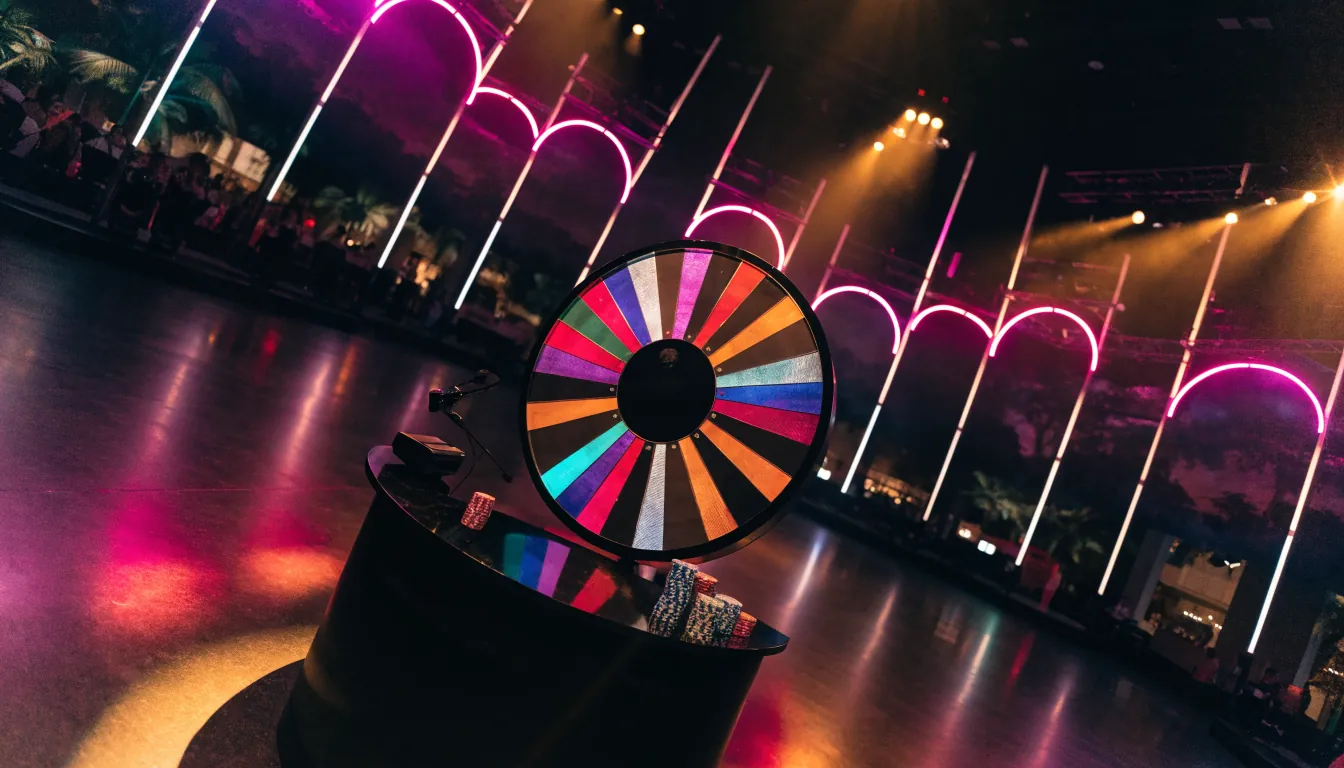
Content
Game shows emphasise an entertainment-style presentation, while live table games centre on familiar rules, decisions and outcomes.
What Makes a Casino Game Show Different from a Live Table Game?
The distinction between a live table game and a casino game show is less about where the action takes place than about what the format asks people to watch. A live table game is organised around a recognisable casino activity: the rules, decisions and outcome of that game provide its centre. A game show borrows the language of entertainment. The casino element remains, but it sits within a presentation designed to feel more like a show than a conventional table session.
That difference sounds simple. In practice, the labels can overlap. Both formats may be described as live casino entertainment, and both are encountered in the same broad online-casino setting. Yet someone looking for a table game may be seeking the familiarity of a known ruleset, while someone interested in a game show may be drawn to a more theatrical kind of presentation. The distinction is one of emphasis, not a guarantee that every title fits neatly into a separate box.
The word “live” can be misleading if taken as a complete description. It tells very little, by itself, about what a game is like. It does not say whether the experience is built around a conventional casino table, a show-like format, or some mixture of the two. Nor does the word establish that every offering labelled live will suit the same audience. It is a broad marker, not a genre in its own right.
A live table game is comparatively easy to picture because its organising idea is already familiar. The table and the rules define the experience. The pace, decisions and result are understood in relation to that central game. Even when the presentation differs from one offering to another, the table-game identity remains the point of reference. The player is there principally to take part in that game.
Slots at UK Online Casinos: Providers and Game Types
A casino game show places greater weight on the format around the gambling. Its identity is not simply “a casino game, shown live”. The entertainment framing is part of what makes it recognisable as a game show. That framing may shape how the experience is described, but it does not, on its own, tell anyone exactly how a particular title works. Without reliable details of an individual game, the sensible distinction stays at the level of category: table games foreground the conventional game; game shows foreground a more entertainment-led format.
That is enough to explain why the two categories attract different expectations. Someone browsing live table games may be comparing familiar kinds of play. Someone exploring online casino game shows may instead be looking for a format with a stronger sense of presentation and occasion. The categories can share the larger live-casino label without answering the same question.
The table is not the whole story
In a traditional casino, the table has long served as both playing surface and social stage. It arranges people around a shared activity and makes the rules visible. The croupier, the layout, the turn-taking and the outcome all belong to a recognisable ritual. Online, that inherited structure still gives live table games their basic identity, even when the setting is presented through a screen.
A game show comes from a different entertainment tradition. Its name suggests a format built to be watched as well as played. That does not mean every online casino game show has the same structure, mood or pace. It means the category signals a different balance between gambling and presentation. The viewer is not being offered only the familiar image of a casino table; the entertainment frame is part of the proposition.
There is a small cultural shift concealed in that difference. The table game carries the authority of established casino customs: rules, turns, calculation, convention. The game-show label draws on the broader culture of broadcast entertainment, where presentation can be as important to recognition as the underlying activity. Casino operators place these ideas together, but the traditions remain distinct. One is organised around a game; the other makes the performance of the format more prominent.
A genre name can orient expectations, but it cannot stand in for a game’s own description or establish specific rules and features.
That performance should not be mistaken for a promise of any particular feature. The category alone does not establish who presents a title, what participants do, how outcomes are produced, or what rules apply. Those are details of individual games, not safe conclusions to draw from a broad label. A genre name can orient expectations; it cannot stand in for a game’s own description.
The distinction also matters because the word “show” can invite assumptions. It may conjure a host, a studio, an audience, a wheel, a quiz or some other familiar device. Such images belong to the wider history of entertainment, but they do not verify the mechanics of any casino title. A responsible description of the category avoids turning associations into facts. The label promises a kind of framing, not a complete inventory of what happens on screen.
A different kind of attention
The difference between table play and show-style play can be understood as a difference in attention. A table game directs attention towards its rules and the choices or events that shape a round. A game-show format invites attention to the way the experience is staged as entertainment. Neither emphasis makes one category inherently more engaging, more social or more rewarding. They simply offer different organising ideas.
This is why “best” is not a neutral word in a discussion of live game shows. A ranking would need a stated basis: rules, presentation, accessibility, pace, or some other criterion. Without that basis, “best” is only an expression of preference dressed as measurement. A title that appeals to someone seeking a show-like atmosphere may not be the right fit for someone who wants the directness of a conventional table game. No universal order follows from the category itself.
Amatic Slots at UK Online Casinos: What to Know · Barcrest Online Casinos UK: What Listings Can Prove
The same caution applies to the phrase “online casino with live game shows”. It can describe a type of catalogue someone hopes to find, but it does not tell whether a particular casino currently offers a particular title. Availability belongs to the operator’s actual catalogue and can change. The general format and the contents of any one casino are separate questions.
There is also a difference between saying that a game is live and saying that it is a game show. The first describes a broad mode of presentation; the second suggests a particular kind of entertainment identity. In ordinary casino language, the terms may appear close together because both sit under the larger live-casino umbrella. But they do not mean the same thing. A live table game need not be a show, and a game show is not defined merely by being presented live.
This distinction is useful precisely because it does not depend on knowing the details of every title. It lets the category be discussed without pretending that a label reveals a full rulebook. The broad contrast is clear: one format takes its identity primarily from the casino game at the table; the other gives more weight to the show-like frame around casino play. The boundary may blur, but the difference in emphasis remains meaningful.
Table vs Show
- Table games foreground the conventional casino game and its rules.
- Game shows foreground an entertainment-led format and presentation.
- The distinction is one of emphasis rather than a strict separation of categories.
What the label can—and cannot—tell
A category name is a starting point, not a substitute for description. “Live casino game show” tells a reader to expect an entertainment-led strand of live casino content. It does not determine whether a particular title is suitable for a newcomer, how long a round lasts, what choices are available, or how its outcomes are determined. Those questions require information about the individual game.
That restraint is especially important when the same broad terms are used in different ways. Casino catalogues are organised for practical browsing, and category labels are meant to help people navigate. They are not necessarily a precise taxonomy shared by every operator. One catalogue’s grouping may not map perfectly onto another’s. The useful approach is to treat the label as a signpost and the game’s own rules and description as the detailed account.
A live game show can therefore be approached as a distinct kind of casino entertainment without treating it as a single uniform product. The phrase covers a category, not one set of mechanics. Its relationship to the live table is close enough that both may appear within the same wider section of an online casino, yet different enough that a person interested in one should not assume the other will provide the same experience.
The difference is not a matter of seriousness. Table games are not necessarily austere, and game shows are not necessarily light-hearted in every detail. Nor does the distinction tell anyone which format is safer, fairer or more suitable. Those judgments require evidence about specific games and operators, not an impression created by a genre name.
IGT Online Casinos UK: How Amatic Fits In
What it does offer is a clearer way to read the menu. A table-game label points towards a conventional casino activity as the central event. A game-show label points towards a format in which entertainment presentation is more prominent. The overlap is real, but it does not erase the contrast. One is organised around the table; the other asks the table to share the stage.
That is the useful distinction. The rest belongs to the individual title.
Live Game Shows and the UK Casino Framework
A live game show offered through an online casino sits within two different kinds of description. One concerns the entertainment itself: what appears on screen and how the programme is presented. The other concerns the business making remote gambling available to customers. In Great Britain, the second has a clear institutional home. The UK Gambling Commission oversees commercial gambling, including online casino activity, and its role does not depend on where the equipment supporting a remote service is located.
That distinction matters because a familiar studio format can make a service feel like television, while its commercial setting remains a gambling operation. The camera, presenter and production style may give a show the grammar of entertainment. They do not, by themselves, establish who is legally responsible for offering it, or whether a particular casino carries it. Those are separate questions.
The regulator’s remit
The UK Gambling Commission is the sole regulator of commercial gambling in Great Britain. Its remit includes remote gambling offered to consumers there, even when the key equipment is situated elsewhere. A service does not fall outside that remit simply because its servers, studios or other infrastructure are based beyond the country.
The UK Gambling Commission’s remit covers remote gambling offered to consumers in Great Britain regardless of where the servers, studios, or other infrastructure are located.
This is an important feature of remote regulation. The physical location of the apparatus and the market in which a service is offered are not the same thing. Online activity crosses borders easily; regulatory responsibility cannot be inferred from a map of where a machine happens to stand. For consumers in Great Britain, the Commission’s oversight follows the remote gambling activity into that market.
The Commission issues operating licences to businesses and personal licences to individuals working in relevant roles. These are not interchangeable permissions. An operating licence concerns a business carrying on regulated activity; a personal licence concerns an individual. The distinction reflects the way commercial gambling is organised: institutions offer services, while people within them may also be subject to individual licensing.
For casino game shows, this framework is relevant at the level of the operator and the gambling activity it offers. It is not a catalogue of programmes. A regulator’s remit can establish which authority oversees commercial gambling without answering whether a named show appears in a particular casino’s lobby today. Oversight and inventory belong to different ledgers.
That difference is easy to blur in promotional language. A licensed casino may present a broad collection of live entertainment, but the existence of a regulatory framework does not certify each title as a recommendation or guarantee that it will remain available. Nor does the presence of a show, considered on its own, explain the operator’s licensing position. The show is part of a service; the operator is the business accountable for offering that service.
Amatic Online Casinos in the UK: How They Work
Licence and catalogue are different things
A UK casino’s licence status and its game-show selection answer different questions. The first concerns the business’s authority to provide regulated gambling in the relevant market. The second concerns what that business has chosen and is able to make available at a given time. One cannot safely be used as a shortcut for the other.
This is why the phrase “live game shows at a UK casino” contains more than one issue. It can refer to a type of entertainment, a casino’s current catalogue, or the regulatory setting in which remote gambling is offered. The Commission’s role clarifies the last of these. It does not, merely by regulating operators, declare that any particular programme is carried by every licensed casino—or by any specific one.
The point is not a technical quibble. Casino lobbies are commercial spaces, shaped by provider arrangements and changing selections. Regulation concerns the conduct of gambling businesses; the contents of a lobby concern the products those businesses offer. Treating the two as identical would make a licence sound like a stamp on every item of entertainment, which is not what the distinction means.
A casino may also be described as a single destination, although its visible offer is made up of separate games and services. The customer-facing name belongs to the operator. The authority to offer remote gambling belongs to the regulated business. The programme appearing within the casino is not itself a substitute for identifying that business. It is an element of the wider service.
A casino’s licence status and its game-show selection are separate; a licence does not guarantee the availability of any specific title.
The relevant boundary is therefore straightforward, if not always conspicuous on screen: a live presentation does not turn commercial gambling into an unregulated broadcast. Where remote gambling is offered to consumers in Great Britain, the Commission’s remit applies regardless of the location of the key equipment. The format may resemble a television show; the commercial activity remains within the gambling framework.
A studio can be somewhere else. The obligation does not vanish with it.
Great Britain and the wider label
“UK” is an ordinary shorthand in casino searches and commercial descriptions, but regulatory statements need a little more care. The Commission is the regulator for commercial gambling in Great Britain, and its remote-gambling remit covers services offered to consumers there regardless of where the supporting equipment sits.
The language of a broad market label can make one jurisdiction sound uniform in every respect. Regulatory descriptions are more exact. Great Britain is the territory named in the Commission’s role as sole regulator for commercial gambling; the UK Gambling Commission also oversees gambling activity in the United Kingdom, including online casinos. These formulations describe the Commission’s remit, rather than supplying a list of every programme or casino available under it.
That precision matters when an entertainment format travels easily across borders. A studio show might be produced in one country, made accessible through a website hosted elsewhere and offered by a business serving customers in Great Britain. The location of the production is not, by itself, the answer to which regulator oversees the remote gambling service. The Commission’s stated remit turns on the service being offered to consumers in Great Britain, not the address of the key equipment.
Wazdan Online Casinos UK: Games and Checks
Equally, a casino’s use of the word “UK” in its branding or promotional material does not, on its own, explain its regulatory status. A brand is a commercial identity. A regulator’s authority is a matter of law and licensing. The words may appear side by side, but they do different work.
What licensing does—and does not—settle
An operating licence is an important part of the framework because it concerns the business providing commercial gambling. Personal licences concern individuals operating within the regulated system. Together, these categories recognise that responsibility is not located only in the software or the screen: it is also attached to organisations and people carrying out regulated functions.
But a licence should not be made to answer questions outside its purpose. It does not tell a customer whether a specific game show is currently offered, what its presentation is like, or whether one casino’s selection is broader than another’s. Those are matters of catalogue and product detail. The regulator’s remit is not a ranking.
This limits what can responsibly be said about “the best” live game-show casinos on regulatory grounds alone. Licensing can be a threshold consideration in understanding the market, but it cannot establish a comparative verdict about entertainment selections. A regulated operator might carry a programme, might not carry it, or might alter its catalogue. The fact of oversight supplies no basis for pretending otherwise.
Regulatory Architecture
Licensing defines the overseen activity and licensed actors, but the specific entertainment menu remains the operator’s own.
There is also a difference between oversight of a business and endorsement of its entire customer experience. Regulation establishes a supervisory relationship; it does not convert each marketing claim or each item in a lobby into a statement from the Commission. The distinction is particularly useful for live formats, where production polish can lend a programme the air of a broadcast institution. A show may look public-facing and familiar. Its commercial context still belongs to the operator offering remote gambling.
The regulator, then, should be understood as part of the market’s architecture rather than as a guide to its entertainment menu. Its authority defines who oversees commercial gambling in Great Britain and reaches remote services even when their equipment is elsewhere. It does not determine which live game show is the most engaging, which title is available at a particular casino, or how one lobby compares with another.
That is a narrower claim than a catalogue review, and a more useful one than a borrowed endorsement. The rules identify the overseen activity and the licensed actors; the changing shop window remains the operator’s own.
For live game shows, the regulatory question is therefore not whether a camera is in Britain or whether a programme resembles television. It is whether remote gambling is being offered to consumers in the territory within the Commission’s remit, and which business holds the relevant operating role. The show’s format may draw attention; the licence attaches to the commercial structure behind the offer.
Amatic Online Casinos in the UK: Provider and Licensing
The boundary is clear. The inventory is another matter.
Recommended online casinos
- SlotoSportBonus: 500% up to £ 10 200+ 777 FS · Payout speed: 1-3 business days
- ChanzeBonus: Slots Welcome Bonus #1 200% up to €500 · Payout speed: 1-3 business days
- x3betBonus: Welcome Pack 100% Up to £1.000 + 200 Free Spins · Payout speed: 1-3 business days
- Revery PlayBonus: 100% up to€1,000+ 100 FS · Payout speed: 1-3 business days
- AmunbetBonus: Join now and get 450% up to 2,700 GBP + 450 FS · Payout speed: 1-3 business days
- NightLuckBonus: Welcome Pack + 805% Up To 6400€ + 280 FS · Payout speed: 1-3 business days
- DieselwinBonus: Welcome Pack 250% up to £4000 + 200 FS · Payout speed: 1-3 business days
- SpinFormulaBonus: 550% Up To £15,000 + 550 FS · Payout speed: 1-3 business days
- NightWinBonus: £900 + 400 free spins · Payout speed: 1-3 business days
- EvoSpinBonus: 125% up to €2500 + 125 Free Spins · Payout speed: 1-3 business days
Crazy Time and Funky Time: Searches Without Verified Game Details
Crazy Time and Funky Time are names that invite a particular kind of expectation. Joined to the words “live casino game show”, each seems to point towards a recognisable product: something with a title, a place in a casino lobby and a set of rules waiting to be learned. But a familiar-sounding name is not itself a description. It cannot establish how a game works, what features it contains, or whether it is currently offered to players in the UK.
That distinction matters because casino language often compresses several different claims into one label. Calling something a game show suggests a category; naming it suggests a particular title; saying it is available in the UK makes a further claim about a current operator’s catalogue. One does not prove the next. A title may be widely discussed without its mechanics being clear, and recognition of a name does not confirm where the product can be played.
For Crazy Time, the name alone does not establish the rules or format. It would be tempting to fill in the blanks with assumptions drawn from the words “live” and “game show”: perhaps a host, a studio, a wheel, a bonus round, or some other familiar piece of television grammar. Those details may sound plausible. Plausibility is not evidence, and attaching them to a named title would turn atmosphere into a product description.
Avoid Assumptions
Assuming rules or features based on a game’s name or category can create a false impression of the actual pace, decisions, and outcomes.
The same caution applies to Funky Time. The wording carries a jaunty tone, but tone is not a feature list. It does not tell whether the title uses a particular type of game, how a round proceeds, what choices are offered, or what the outcomes mean. Nor does the shared word “Time” establish that it works like Crazy Time, or that the two titles belong to the same provider or catalogue. Similar names are not a reliable guide to shared mechanics.
This is not pedantry. Rules are the part of a casino product that determine what a participant is actually doing. If a description invents them, even in passing, it can create a false impression of the game’s pace, decisions or possible outcomes. A confident account built from a title may read smoothly; it still leaves the reader with information that has not been earned.
The phrase “live casino game show” can also obscure the difference between a genre label and an individual game. The category may be meaningful in general, while the details of a particular named product remain unconfirmed. Treating the label as proof of a specific design reverses the order of explanation: it begins with an assumption and then writes the missing product around it. Better to leave the outline unfinished than to make it look complete.
New Online Casino Sites in the UK: What to Check
Availability is a separate question. A title appearing in discussion, in a promotional image or in a list on an old page would not, by itself, establish that a UK-facing casino offers it now. A casino’s catalogue is an operator-level matter, not something that follows automatically from the existence of a product name. Nor can a title’s apparent popularity settle where it is accessible. For Crazy Time and Funky Time alike, the name does not confirm current UK availability.
That leaves a modest but useful description: these are named products associated in the wording of the topic with casino game shows, but their specific rules, features and UK availability should not be asserted on that basis alone. It is less satisfying than a brisk comparison, but more accurate. The alternative would be to present imagined detail as practical guidance, which is a peculiar way to make a reader better informed.
Amatic Online Casinos in the UK: Games and Rules
A comparison would require confirmed information about both games. Without it, claims that one is faster, more interactive, more familiar, or better suited to a particular kind of player would have no sound footing. Even a simple contrast of features would imply that those features had been checked. There is no honest shortcut from two names to a ranking.
The careful reading is therefore a narrow one. Crazy Time and Funky Time can be recognised as the titles in question; the names alone cannot carry the rest. No invented rules, no borrowed mechanics, no confident promise of a UK listing. Sometimes restraint is the whole description.
The Live Casino Game-Show Search, Carefully Defined
A live casino game show is best understood as a broad description, not a precise promise about what will happen on screen. The words combine a setting, a mode of presentation and a kind of entertainment. They do not, by themselves, identify a particular game, explain its rules or establish what a casino currently offers.
That distinction matters because familiar labels can feel more definite than they are. “Live” may suggest an experience unfolding in real time; “game show” evokes a recognisable entertainment tradition. Put together, the phrase gives a general direction. It still leaves many questions unanswered: what participants do, how outcomes are determined, whether there is a presenter, and what choices a player can make. Those details belong to an individual title, not to the broad category.
The expression “live game show casino” points to much the same territory, with the emphasis shifted. One version begins with the live format; the other places the casino first. Neither wording settles whether two products are alike, or even whether they share anything beyond a loose entertainment label. Search language is economical. It is not a rulebook.
Do
- Use category labels as general signposts for browsing.
- Refer to a game’s own rules for detailed information.
- Check the operator’s current catalogue for availability.
Don’t
- Treat a genre label as a precise technical specification.
- Assume “live” implies a specific host or schedule.
- Use category names to verify a game’s internal mechanics.
A label, not a specification
In everyday use, a category name can help distinguish one kind of casino entertainment from another. It can also become a container for products that differ substantially. The phrase alone cannot show how any particular title works, how it is presented, or what its terms are. Treating the label as a specification would turn an impression into a claim.
The same restraint applies to the word “live”. It should not be stretched into assumptions about a named host, a particular studio, a fixed schedule or a specific interaction. Those may be details attached to an individual offering, but they are not guaranteed by the category name. Nor does the word “show” establish that a game follows the rules or structure of a television programme. It signals an entertainment association, not a complete description.
This is less a defect in language than a feature of it. Categories make browsing possible by compressing detail into a few words. The compression is useful until it is mistaken for evidence. Then the label starts doing work it cannot do.
What the wording can—and cannot—tell
The broad phrase can identify the kind of subject being considered: casino entertainment presented as a live game-show experience. It cannot supply the missing particulars of a title. A careful description therefore separates the general idea from any claim about a specific product.
That separation is especially important when choosing between offerings. A shared category name does not establish shared rules, pacing, presentation or player options. Those require product-level information. In the absence of such detail, comparison becomes guesswork dressed up as analysis.
Amatic Games at UK Online Casinos: How They Work
Nor does the category alone say whether a particular title is available at a particular casino. A description of a type of entertainment is not a live inventory. A casino’s offering can only be established by its own current catalogue; a general phrase cannot stand in for that check. This is a modest point, but a consequential one: labels describe, while catalogues show what is offered.
There is also a difference between describing an experience and recommending it. Calling something a live casino game show does not establish its quality, suitability or value. Those judgments depend on details that the umbrella term leaves open. A confident recommendation built from the category alone would have a polished surface and a hollow centre.
Keeping the category in proportion
The useful meaning of the phrase is therefore deliberately limited. It names a broad area of casino entertainment, not a uniform product with guaranteed features. It can help orient a reader without deciding the details for them. That is enough for a category label to do.
The boundary is simple: general language can describe the broad kind of experience; claims about a particular game need to rest on that game’s own information. Without that distinction, “live game show” can become a catch-all that appears informative while concealing how much remains unspecified. Better to leave the edges visible.
A name is not a mechanism. A category is not a catalogue. And the word “live” does not make every detail immediate or self-evident.
Are Amatic casinos safe and regulated in the UK?
Amatic is a software supplier, not a casino operator, and it holds a UK Gambling Software (Remote) licence. The casino you use must hold the relevant UKGC licence for deposits, payouts and customer support.
Are Amatic games licensed and legal to play in the UK?
Yes. Amatic holds a UK Gambling Software (Remote) licence, and its games are distributed to UK players through UKGC-licensed operators.
What are the wagering requirements at Amatic casino bonuses in the UK?
UK rules cap wagering requirements on bonus funds at 10×, effective from 19 December 2025. The casino operator sets the specific bonus terms.
Which licensed UK casinos carry Amatic slots?
Operators listed as carrying Amatic games include Betfred, Bet365, William Hill, 32Red, Sky Vegas, 888casino, Betway, Betfair, Ladbrokes, Paddy Power, Unibet, PokerStars, Virgin Games, Casumo, Jackpotjoy, kwiff and Betvictor. Check the casino’s current provider list, as availability can vary.
How does the UK’s 10× wagering cap affect Amatic casino bonuses?
Since 19 December 2025, wagering requirements on bonus funds at UK-licensed casinos cannot exceed 10×. The operator’s bonus terms explain how that cap applies to a particular offer.